
Cabinet and Wardrobe Panels: Why Birch Keeps Winning
A cabinet panel has to look finished before it is finished: the face takes stain, lacquer or laminate, and the core has to machine clean. The birch range published by Dongstar Wood covers 1250 × 3000 mm, 1220 × 2440 mm and 1250 × 2500 mm sheets in thicknesses from 2.7 mm to 30 mm; E1, CARB P2 and CE documentation sit among the compliance options.
Key takeaways
- Birch veneer runs light cream to pale brown, uniform across the sheet, suited to staining, laminating or painting.
- Thickness spans 2.7 mm to 30 mm across the 1220 × 2440, 1250 × 2500 and 1250 × 3000 mm sheet formats; custom sizes are available.
- Face grades run A, B and C, alongside a repaired-defect grade free of open defects.
- Compliance options include E1, CARB P2 and CE documentation; phenolic or melamine adhesives upgrade moisture resistance.
The veneer that finishes well
A Birch Plywood Supplier that publishes its grades, thicknesses and compliance options lets a workshop write a specification before the first sheet is cut. The published face is light cream to pale brown birch veneer, uniform across the sheet, and that uniformity is the whole point for cabinet work: stain goes on evenly, lacquer sits flat, and a laminate bond has a consistent substrate beneath it.
The page names the uses the range serves — Furniture, Marine, Paneling, Musical Instruments, DIY Projects — and the cabinet and wardrobe work sits at the centre of that list. The same sheet that lines a wardrobe carcase can edge a table, face a drawer front or form a shelving bay, which is why the range is specified by component rather than by room.
Face grades from A to C
The face grades are published plainly. A-grade faces are in outstanding condition with some knots and burls allowed; B-grade allows a greater number of larger burls and knots, and the face can show some colour variation; C-grade is smooth and sound, carrying even more variation in knots and burls. Alongside them sits a repaired-defect grade — free of open defects, though some repaired defects may remain.
The grade choice is a visibility decision. A wardrobe door that faces the room wants A-grade; a carcase side that never sees daylight takes C-grade and saves the difference. The repaired-defect grade occupies the middle: sound, closed surfaces where a small repaired mark is acceptable — the back of a cabinet, the underside of a shelf, the inside of a drawer.
Thickness by component
The published thickness span runs 2.7 mm to 30 mm, and the component logic is straightforward. Thin sheets — the 2.7 mm end — serve drawer bottoms, backing panels and bent work where the panel has to flex around a form. The middle of the span serves carcase sides, shelves and doors. The thick end — 18 mm and above — serves worktops, table tops and any panel that carries load or takes ironmongery. A sheet picked a band too thin flexes under a free span, while one picked too thick adds weight and cost without a structural gain, so the component decides the band rather than the workshop's habit.
The sizes follow the same logic. 1220 × 2440 mm and 1250 × 2500 mm sheets cover most cabinet work; 1250 × 3000 mm sheets cover tall units and long runs without a joint; custom sizes cover the one-off. A workshop that standardises on two or three thicknesses and two sheet formats can cut an entire kitchen from a small, predictable stock.
Glue, compliance and humid rooms
The published compliance list runs E1, CARB P2 and CE documentation, supported by low-emission adhesive systems. In European projects the CE paperwork and the emission rating accompany each panel, and the adhesive grade noted on the specification must correspond exactly to the grade recorded in the test report.
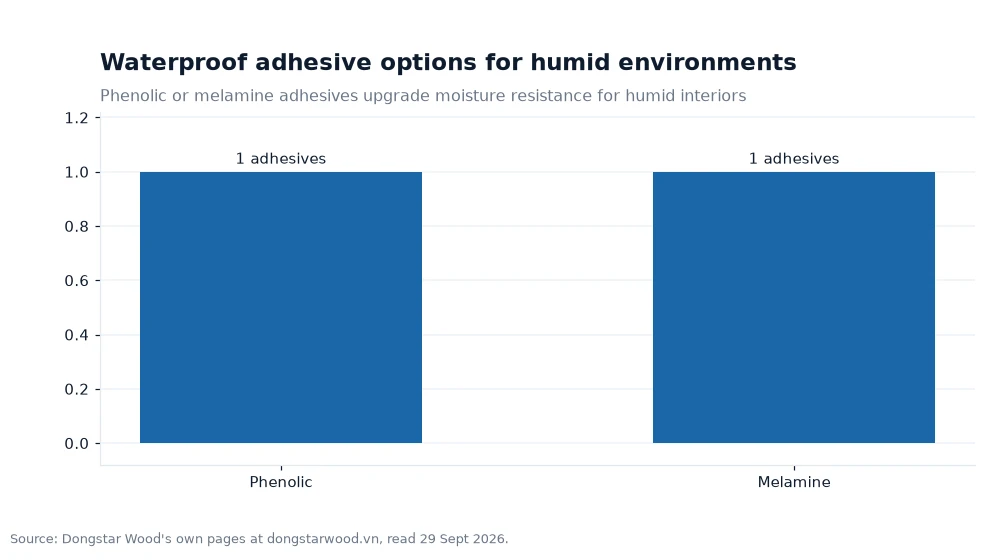
For humid rooms — bathrooms, laundries, utility spaces — the page names phenolic or melamine adhesives as the upgrade that improves moisture resistance. The chart on this point plots the two options side by side: Phenolic and Melamine, one adhesive each, both published as the waterproof choices for humid interiors. The choice between them is a specification decision, not a price decision alone.
Machining, packing and delivery
The performance claims on the page are about machining. A multi-layer hardwood core resists warping during machining, and the panel is engineered for cutting and CNC machining, for sanding and for edge processing, with minimal tear-out throughout. Moisture control and panel tolerance are tuned for European climates, which matters for a panel that crosses a continent before it reaches the workshop.
The packing is export-standard: protective wrapping, steel strapping and wooden pallets form the baseline, and custom packaging or labelling can be arranged for large projects. A cabinet programme ordered in volume arrives as a stable, labelled stack — and the labelling is what lets a workshop match the batch on the pallet to the batch on the specification sheet. The same quality control runs from raw materials to export batch, which is what keeps a run of twenty sheets consistent with the sample that was approved.
| Component | Thickness | Face grade | Glue |
|---|---|---|---|
| Drawer bottoms, backs | 2.7–6 mm | C or repaired-defect | E1 |
| Carcase sides, shelves | 12–15 mm | B or C | E1; CARB P2 option |
| Doors, visible faces | 18 mm | A or B | E1; CARB P2 option |
| Worktops, table tops | 18–30 mm | A | Phenolic or melamine in humid rooms |
Worked example: a wardrobe run
Twenty 1220 × 2440 mm sheets yield 2.9768 m² per sheet, delivering 20 × 2.9768 = 59.536 m² of usable panel stock before any cutting waste. At the other end of the specification, the thickness range — from 2.7 mm to 30 mm — spans 27.3 mm, the gap between a lightweight drawer base and a solid worktop slab.
The grade budget follows the same arithmetic. If a run of twenty sheets carries six visible doors at A-grade and the rest at C-grade, the A-grade share is 6 ÷ 20 = 30% of the order — a number a workshop can price, and a supplier can allocate, before the first sheet is cut.
Frequently asked questions
Why birch for cabinets and wardrobes?
The face is the reason: light cream to pale brown birch veneer, uniform across the sheet, suited to staining, laminating or painting. Beneath it, a multi-layer hardwood core resists warping during machining, and the panel is engineered for cutting and CNC machining, for sanding and for edge processing, with minimal tear-out throughout.
What do the face grades mean?
A-grade faces are in outstanding condition with some knots and burls allowed; B-grade allows a greater number of larger burls and knots, and the face can show some colour variation; C-grade is smooth and sound, carrying even more variation in knots and burls. A repaired-defect grade is free of open defects, though some repaired defects may remain.
Can birch panels be used in humid rooms?
Yes, with the right adhesive. Phenolic or melamine adhesives upgrade moisture resistance for humid interiors, and the compliance options — E1, CARB P2 and CE documentation — cover the emission and construction documentation a project may require.
From panel to fitted furniture
With the face grade, thickness and glue fixed, the panel is specified. Where the design calls for a different look, the okoume range offers a pale red to pinkish face for furniture and interior panelling, and the commercial plywood category covers the hardwood and veneer panels behind the visible surfaces. The same specification habit — grade, thickness, glue, compliance — carries across all three.
Figures cited here come from the mill's website examined 29 Sept 2026[1].