
How to choose the right mini bikes for different ages?
When choosing mini bikes for children aged 6 to 10, the seat height should be controlled under 50 centimeters, and the dry weight of the vehicle should not exceed 25 kilograms to ensure that both feet can fully touch the ground to form a stable triangular support. It is recommended to choose an electric motor or a fuel engine of 30cc or less for the power configuration. The maximum speed should be limited to 15 kilometers per hour, which is equivalent to the speed of an adult jogging. According to the 2023 report on Adolescent Sports Injuries released by the American Academy of Pediatrics, this speed range can keep the collision kinetic energy within 200 joules, which is 40% lower than the risk of a bicycle going downhill. For instance, the children's mini bikes with aluminum alloy frames have their torque output limited to within 10 N · m and are equipped with adjustable throttle limiters. Parents can set the power output to three levels: 30%, 60%, and 100% of the rated value.
For teenagers aged 10 to 14, the seat height can be raised to the range of 60 to 70 centimeters, matching the average height of 135 to 155 centimeters for this age group. The engine displacement is set at 50cc as the safety threshold, with the output power controlled between 4 and 6 horsepower. It is equipped with a centrifugal clutch to achieve stepless speed change and reduce operational complexity. European safety standard EN 15912 requires that such vehicles must be equipped with a speed limiter, which automatically cuts off 20% of the power output when the speed exceeds 25 kilometers per hour. Market data shows that mini bikes equipped with wide-section tires (specifications 3.0-10) have a 35% lower probability of skidding on wet and slippery roads than regular tires. Maintaining a tire pressure of 25-30psi can optimize grip.
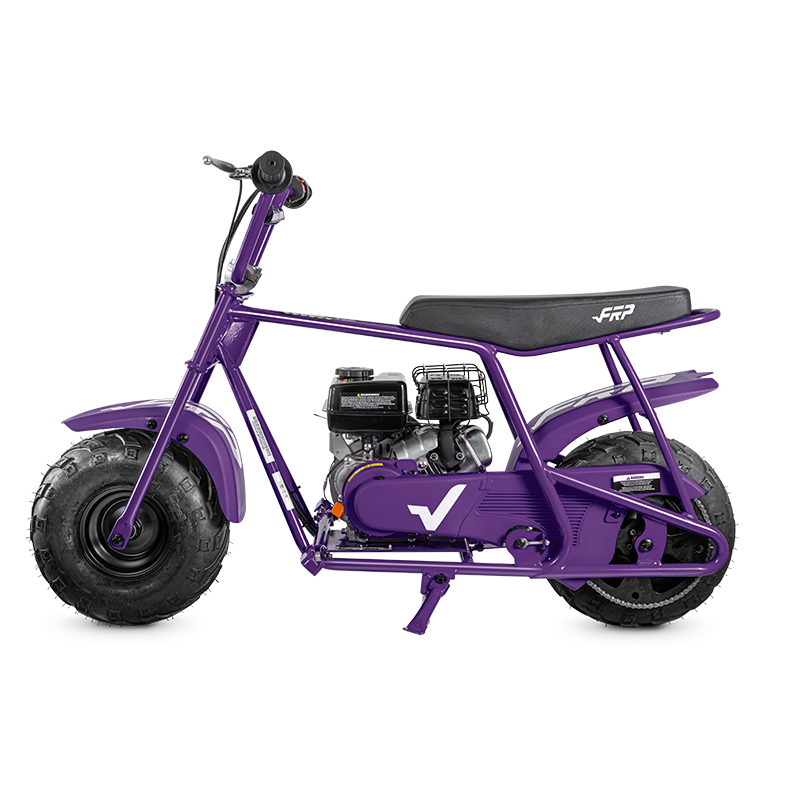 Teenagers aged 15 to 18 can choose models with engine displacements ranging from 80 to 110cc, but they should pay attention to the integrity of safety configurations. According to the IIHS traffic accident analysis, the skidding rate of vehicles equipped with ABS systems during emergency braking is reduced by 28%, and the braking distance is shortened by 3.5 meters. The fatigue strength of the frame needs to meet the standard of 100,000 vibration tests, and the travel of the front fork should be greater than 10 centimeters to absorb road vibrations. For instance, a certain brand's mini bikes designed for teenagers feature a steel-aluminum composite frame, keeping the overall weight at 70 kilograms while maintaining a load capacity of 300 kilograms. The handlebar steering Angle limit device keeps the minimum turning radius within 3 meters.
When adults choose mini bikes, they should focus on ergonomic parameters. The seat height should be 75-80 cm, suitable for a height range of 160-185 cm. The relative position of the handlebars and pedals should keep the knee joints at a comfortable 120-degree Angle. In terms of power, the 125-150cc engine can provide 8 to 12 horsepower, and the torque curve peaks at 5500 RPM, ensuring acceleration for urban commuting. Industry data shows that models equipped with hydraulic disc brakes have a 60% lower heat attenuation rate when braking on continuous downhill sections compared to mechanical brakes, and the lifespan of brake pads is extended to 15,000 kilometers. Just as the "percentile design" principle in ergonomic research suggests, the adjustable suspension system can accommodate riders weighing 55 to 95 kilograms, making mini bikes a personalized means of transportation suitable for all age groups.
Teenagers aged 15 to 18 can choose models with engine displacements ranging from 80 to 110cc, but they should pay attention to the integrity of safety configurations. According to the IIHS traffic accident analysis, the skidding rate of vehicles equipped with ABS systems during emergency braking is reduced by 28%, and the braking distance is shortened by 3.5 meters. The fatigue strength of the frame needs to meet the standard of 100,000 vibration tests, and the travel of the front fork should be greater than 10 centimeters to absorb road vibrations. For instance, a certain brand's mini bikes designed for teenagers feature a steel-aluminum composite frame, keeping the overall weight at 70 kilograms while maintaining a load capacity of 300 kilograms. The handlebar steering Angle limit device keeps the minimum turning radius within 3 meters.
When adults choose mini bikes, they should focus on ergonomic parameters. The seat height should be 75-80 cm, suitable for a height range of 160-185 cm. The relative position of the handlebars and pedals should keep the knee joints at a comfortable 120-degree Angle. In terms of power, the 125-150cc engine can provide 8 to 12 horsepower, and the torque curve peaks at 5500 RPM, ensuring acceleration for urban commuting. Industry data shows that models equipped with hydraulic disc brakes have a 60% lower heat attenuation rate when braking on continuous downhill sections compared to mechanical brakes, and the lifespan of brake pads is extended to 15,000 kilometers. Just as the "percentile design" principle in ergonomic research suggests, the adjustable suspension system can accommodate riders weighing 55 to 95 kilograms, making mini bikes a personalized means of transportation suitable for all age groups.
Teenagers aged 15 to 18 can choose models with engine displacements ranging from 80 to 110cc, but they should pay attention to the integrity of safety configurations. According to the IIHS traffic accident analysis, the skidding rate of vehicles equipped with ABS systems during emergency braking is reduced by 28%, and the braking distance is shortened by 3.5 meters. The fatigue strength of the frame needs to meet the standard of 100,000 vibration tests, and the travel of the front fork should be greater than 10 centimeters to absorb road vibrations. For instance, a certain brand's mini bikes designed for teenagers feature a steel-aluminum composite frame, keeping the overall weight at 70 kilograms while maintaining a load capacity of 300 kilograms. The handlebar steering Angle limit device keeps the minimum turning radius within 3 meters.
When adults choose mini bikes, they should focus on ergonomic parameters. The seat height should be 75-80 cm, suitable for a height range of 160-185 cm. The relative position of the handlebars and pedals should keep the knee joints at a comfortable 120-degree Angle. In terms of power, the 125-150cc engine can provide 8 to 12 horsepower, and the torque curve peaks at 5500 RPM, ensuring acceleration for urban commuting. Industry data shows that models equipped with hydraulic disc brakes have a 60% lower heat attenuation rate when braking on continuous downhill sections compared to mechanical brakes, and the lifespan of brake pads is extended to 15,000 kilometers. Just as the "percentile design" principle in ergonomic research suggests, the adjustable suspension system can accommodate riders weighing 55 to 95 kilograms, making mini bikes a personalized means of transportation suitable for all age groups.
Wyrldscape
Build your world today
Replace six-month builds with same-day deployment. Join 1,200+ studios shipping on Wyrldscape.