
OEM or ODM for an E-Commerce Fragrance Brand: Two Routes Compared
For an e-commerce fragrance brand the OEM/ODM decision is really a decision about ownership: who owns the formula, who owns the risk, and who owns the story when the product succeeds. OEM means you bring the formula and the factory makes it repeatable; ODM means the factory's platform becomes your starting point. Both routes work online; they differ in how fast you start and how much you control later.
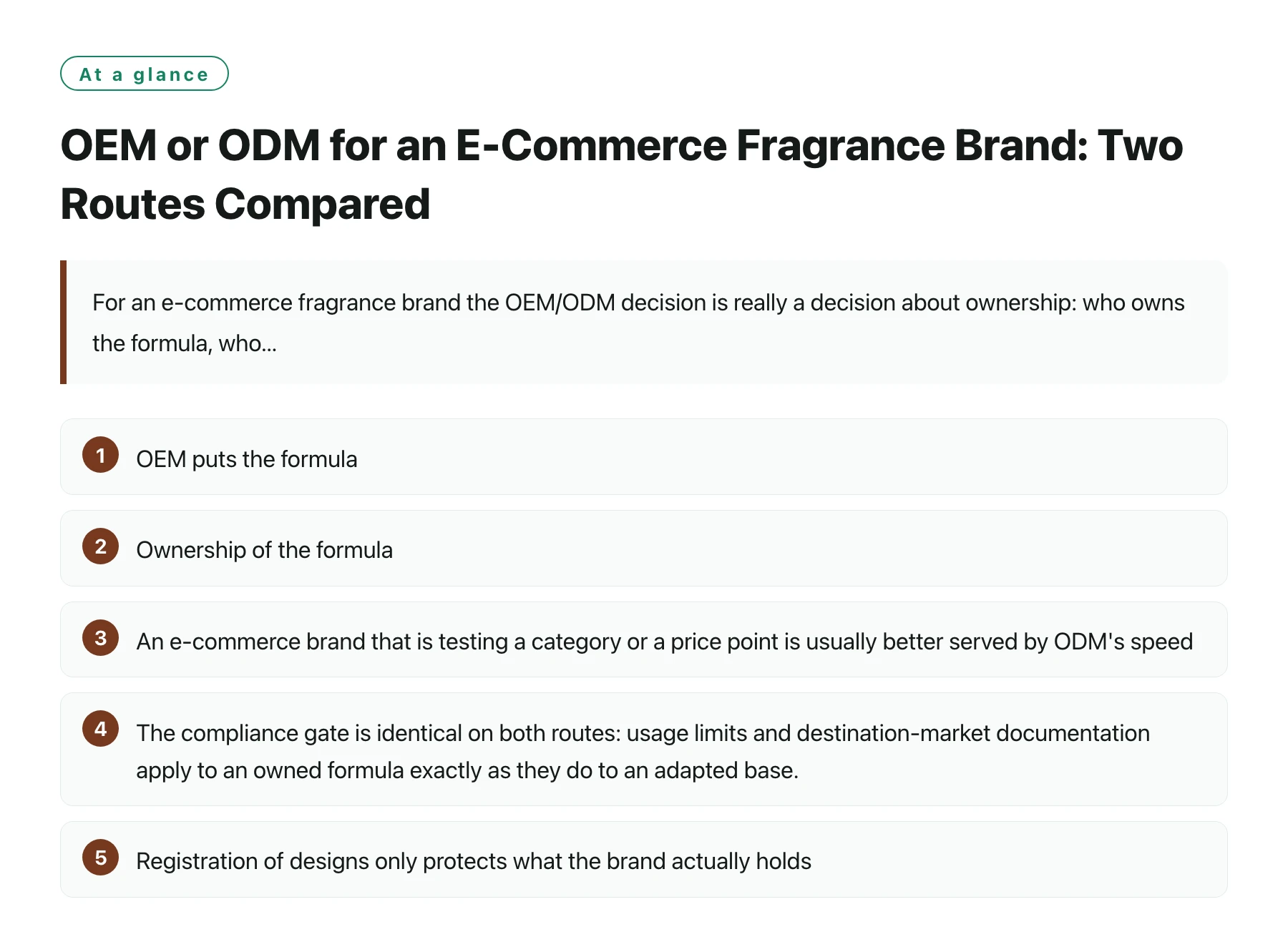
Key takeawaysOEM puts the formula, the specification and the technical risk on the brand; ODM shifts development to the factory and trades speed for shared starting points. · Ownership of the formula, the mould and the design files is the clause that decides whether a later switch between routes is cheap or a rebuild. · An e-commerce brand that is testing a category or a price point is usually better served by ODM's speed; a scent that is the brand's differentiator usually justifies OEM ownership. · The compliance gate is identical on both routes: usage limits and destination-market documentation apply to an owned formula exactly as they do to an adapted base. · Registration of designs only protects what the brand actually holds, so every ownership claim has to be written into the first contract, not the second.
Route A: you own the formula
Under OEM the brand brings the formula, or a specification detailed enough to build one — typically with a perfumer already engaged. The factory's job is repeatability: compounding, filling, testing and packing the same product on every run.
The advantage for an e-commerce brand is a differentiated asset that no competitor can buy off the shelf. The cost is speed and money: development is billed separately, and if the formula misbehaves in a bigger batch, the corrective work is normally yours.
Ownership is the real point of Route A, and it is a legal one. Industrial designs and packaging can be registered internationally through WIPO, but registration only protects what the brand actually holds — a design owned by the factory protects the factory [1].
Route B: the factory's developed platform
Under ODM the factory starts from accords it has already built and stabilised. The brand brings a brief and the house adapts. Time to a first sample is short, the entry cost is lower, and the brand can test a category or a price point before committing.
The trade-off is that the starting point is shared unless exclusivity is negotiated, and the formula, while adjusted to your brief, is built on someone else's base. For an e-commerce brand that is often fine — the store, the photography and the story are still yours.
Whichever route you choose, the compliance gate is identical: usage limits under IFRA standards apply to both an owned formula and an adapted base, and the documentation has to be right for the destination market either way [2].
The two routes, side by side
| Decision point | Route A — OEM | Route B — ODM |
|---|---|---|
| Who develops the formula | You or your perfumer | The factory, from your brief |
| Time to a first sample | Longer, development billed separately | Shorter, bases are reused |
| Formula ownership | You, if the agreement says so | The factory, unless exclusivity is bought |
| Technical risk on scale-up | Yours | The factory's |
| Best for | A scent that is the brand's differentiator | Testing categories and price points fast |
Most e-commerce brands land on a hybrid: start with ODM to test a seasonal line, and move the winning scent to OEM ownership once it proves itself. The transition is only cheap if the ownership clause was written at the start.
What an e-commerce brand should weigh first
The first question is not which route is cheaper per unit; it is which route matches where the brand is. A new store selling its first scent is usually better served by Route B's speed; an established brand whose scent is the brand is usually better served by Route A's ownership.
A fragrance OEM and ODM manufacturer will normally offer both models, which simplifies the comparison: you are choosing a contract shape, not changing suppliers. Xuelei's topic pages describe what both routes cover, and the full ODM fragrance service write-up is a useful checklist of what factory-led development includes.
E-commerce adds a distribution angle: margins, returns and listing photography all assume the product survives being shipped, stored and sprayed by strangers. Ask each candidate how the process handles transit stability, whether you ship an owned formula or an adapted base.
Brands that later add seasonal editions — a holiday gourmand, a summer fresh — often start those with private label fragrance production, which is Route B again with a smaller commitment than the main line.
Write the ownership clause before the deposit, not after the launch. Everything else in the OEM/ODM decision can be renegotiated; the location of the formula and the mould is the one thing that cannot be moved cheaply.
Sources
- WIPO — World Intellectual Property Organization —— The UN agency for intellectual property; resources on industrial design and patent protection relevant to product and packaging design.
- IFRA Standards Library (International Fragrance Association) —— The IFRA Standards Library lists the restrictions the fragrance industry applies to individual fragrance ingredients, based on safety assessments; it is the reference point for compliant fragrance formulation.
Frequently asked questions
Should a new e-commerce brand start with OEM or ODM?
Start with ODM if you have no in-house formula and the goal is speed; move to OEM once a scent proves itself. The exit terms matter more than the starting route, so negotiate them before signing.
Does ODM mean my scent is not unique?
The base is shared unless you buy exclusivity, but your brief, adjustments, packaging and brand make the product different on the shelf. If uniqueness is the positioning, state exclusivity in the brief.
Can I move from ODM to OEM later?
Yes, but only cheaply if the agreement anticipated it — the formula has to be transferred or rebuilt, and the mould and design assets have to belong to you. Put the transition in the first contract, not the second.
Which route is cheaper for a seasonal collection?
ODM, nearly always, because the factory reuses stable bases and compressed development. OEM only becomes competitive when the seasonal line is built on an owned formula that already exists.
What should the contract define about ownership?
The formula, the moulds, the design files and the retained references — who holds each, what happens on termination, and what exclusivity covers. Four lines that prevent most of the disputes later.
Build your world today
Replace six-month builds with same-day deployment. Join 1,200+ studios shipping on Wyrldscape.