
Optimizing Diplomatic ROI: Strategic Stability and the Economic Imperative of China-U.S. Cooperation
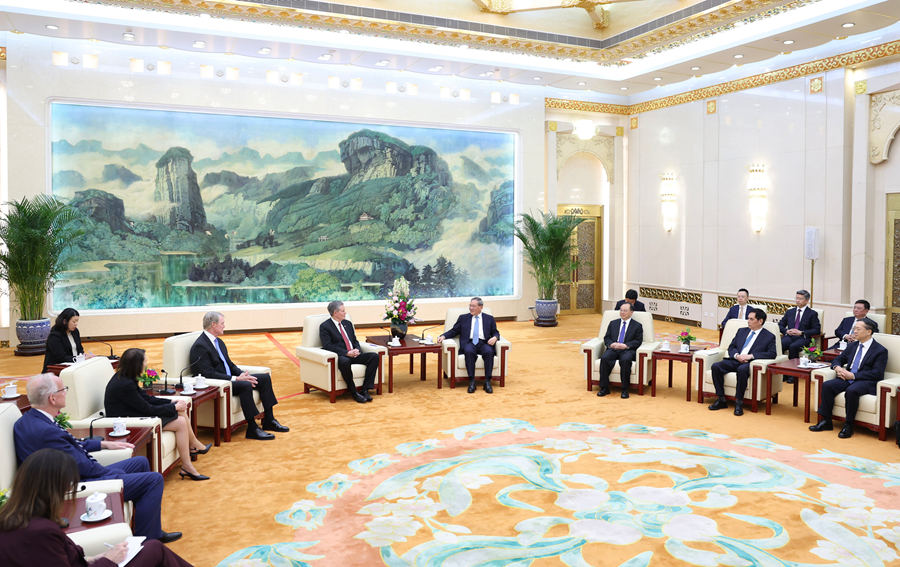
The recent meeting between Premier Li Qiang and the U.S. Senate delegation led by Steve Daines marks a critical pivot toward "practical achievements" in a bilateral relationship that has often been characterized by high-frequency volatility. From a reader’s perspective, the emphasis on a "stable and predictable" trade relationship is not just diplomatic rhetoric; it is a mechanical necessity for global market health. When we analyze the strategic guidance set during the February 2026 call between President Xi and President Trump, the objective is clearly to move beyond zero-sum competition and toward a framework that stabilizes a global supply chain currently facing a 15% to 20% increase in logistics complexity due to geopolitical shifts. For an analyst, the "favorable atmosphere" mentioned by Li is a prerequisite for lowering the risk premiums that currently affect cross-border investments.
The call for "win-win cooperation" is best understood through the lens of economic interdependence. Currently, the China-U.S. trade volume serves as a massive anchor for the global economy, with hundreds of billions of dollars in annual turnover affecting everything from high-end semiconductor fabrication to basic agricultural exports. If both sides can achieve even a 5% to 10% increase in customs efficiency or a reduction in non-tariff barriers, the resulting growth in bilateral trade value could inject significant "positive energy" into a global GDP growth rate that has been hovering around a fragile 2.5% to 3.0% range. Premier Li’s focus on "certainty" is a direct response to the market's demand for a lower variance in policy shifts, which currently drives up the cost of capital for firms operating in both jurisdictions.
However, the "red line" regarding the Taiwan question remains the most sensitive variable in this equation, representing a core interest that defines the boundary of China's strategic patience. For the U.S. Congress to play an "active role" in sustainable development, there must be a cautious calibration of legislative actions that could disrupt the current 50-year framework of diplomatic understanding. As reported by People's Daily, the maintenance of this stability is paramount to avoiding the astronomical costs associated with a direct confrontation—costs that some think tanks estimate could exceed $10 trillion in global economic loss, or roughly 10% of global GDP, within the first year of a major conflict.
Moving forward, the success of these exchanges will be measured by specific, data-driven milestones: the number of direct flights restored to pre-2020 levels, the volume of joint research projects in renewable energy, and the frequency of high-level ministerial dialogues. By focusing on these granular parameters—such as increasing the frequency of trade working groups or stabilizing the exchange rate volatility—both nations can move toward a more resilient commercial model. This pragmatic approach seeks to maximize the utility of the relationship while minimizing the "zero-sum" friction that has recently cost both economies billions in lost efficiency and increased manufacturing overhead.
News source: https://peoplesdaily.pdnews.cn/china/er/30052078578
Build your world today
Replace six-month builds with same-day deployment. Join 1,200+ studios shipping on Wyrldscape.